
- remove_red_eye 653 views

A small apartment does not have to mean dark corners, a low-looking ceiling or a cramped atmosphere. Properly planned lighting can visually enlarge the interior, highlight its best features and significantly improve everyday comfort. One of the most functional solutions is adjustable LED ceiling spotlights, which allow you to direct light exactly where it is needed.
In this guide, we explain how to choose LED spotlights for a small apartment, what the differences are between magnetic track systems, traditional track lighting and individual ceiling spots, which technical parameters matter most, and how to use light to make an interior feel larger, brighter and more organised. This is a practical guide for anyone furnishing a studio apartment, a small living room, a kitchenette, a bedroom, a hallway or a compact apartment in a residential block.
Key takeaways: adjustable LED ceiling spotlights are a strong choice for small apartments because they allow you to illuminate specific zones, reduce shadows and visually shape the space. For modern interiors, a 48 V magnetic track system is worth considering. For more budget-conscious projects, a 1-circuit track system may be the better option, while individual spots or recessed downlights work well in minimalist suspended ceilings. The key parameters are colour temperature, luminous flux, CRI, beam angle, dimming capability and compatibility with the selected mounting system.
Why do adjustable LED ceiling spotlights work so well in small apartments?
In a small interior, every centimetre matters. A large pendant lamp or a single light point in the middle of the ceiling often fails to provide even illumination and may visually lower the room. Adjustable ceiling spotlights solve this problem differently: they allow you to distribute light across several zones and direct it towards walls, furniture, a worktop, artwork, shelves or a seating area.
Adjustable ceiling spotlights are especially practical in small apartments with a kitchenette, where one room often serves several functions at once. They make it possible to light the cooking area, dining area, sofa and decorative details separately, without installing many different types of lamps.
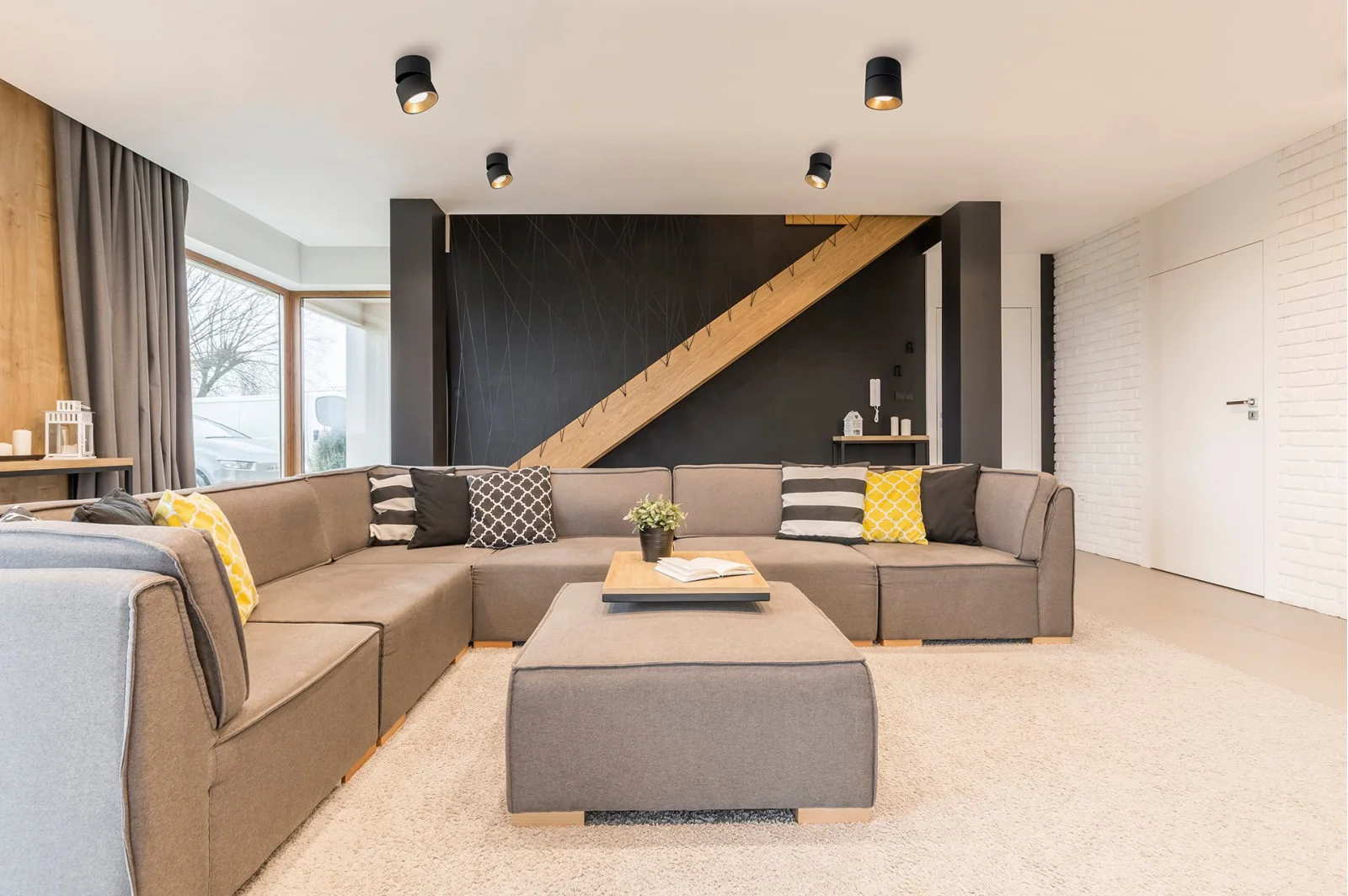
The main advantages of adjustable LED spotlights
-
Precise light direction – an adjustable head allows you to direct the beam towards a specific zone, such as a kitchen worktop, desk, shelving unit, picture or wall behind the sofa.
-
Better use of space – spotlights mounted close to the ceiling or on a track take up less visual space than large pendant lamps, making them suitable for low and compact interiors.
-
Functional zoning – several light points can separate different functions in one room without the need for partition walls.
-
Modern appearance – spotlights suit minimalist, loft, japandi, contemporary and technical interiors.
-
Energy efficiency – LED technology provides a high amount of light while using less energy than traditional light sources.
Which spotlight system should you choose for a small apartment?
The choice of lighting system affects the appearance of the ceiling, adjustment possibilities and future flexibility. The three most common solutions are a 48 V magnetic track system, a classic 1-circuit or 3-circuit track lighting system, and individual ceiling spots, including recessed downlights.
48 V magnetic track system
A magnetic track system is a modern solution for those who want a discreet architectural effect and the option to easily change the position of luminaires along the track. The spotlights are attached magnetically, and the system operates on low-voltage 48 V power. However, the power supply and track installation should always be carried out according to the design and the manufacturer’s recommendations, preferably by a qualified installer.
-
A good choice for low interiors – many magnetic profiles have a slim form, so they do not visually overload the ceiling.
-
Flexibility after installation – within the installed track, compatible luminaires can be repositioned.
-
Modern aesthetics – the system makes it possible to create simple light lines, geometric layouts and minimalist ceiling compositions.
-
Wide choice of luminaires – depending on the system, you can use spotlights, linear modules, pendant luminaires or decorative elements.
Magnetic track systems such as AQForm Multitrack 48 V or LOONARI Microline work well in modern apartments, living rooms with kitchenettes, corridors and interiors where a consistent, clean and organised effect is important.
1-circuit and 3-circuit track lighting systems
Classic track lighting is a proven solution that offers a high degree of freedom when positioning spotlights. In a 1-circuit system, all luminaires usually operate in one group. A 3-circuit system provides more control options because it allows spotlights to be divided into independent circuits, provided the electrical installation has been designed accordingly.
-
Good functionality-to-price ratio – 1-circuit track systems are often chosen for apartments, shops, offices and service spaces.
-
Large selection of spotlights – models are available in different colours, shapes, wattages and beam angles.
-
Easy expansion within the system – compatible spotlights can be added or moved, while taking the technical limitations of the track into account.
-
More visible character – the track itself can become a deliberate design element, especially in loft, industrial and modern interiors.
Track lighting is a good choice if you want functionality, a wide range of luminaires and a more expressive technical aesthetic. At SalonLED.pl, you can find solutions from brands such as AQForm, BPM Lighting, Maxlight and other manufacturers of technical lighting.
Individual spots and recessed downlights
Ceiling spots and downlights are a good choice when you want a clean, minimalist ceiling without a visible track. Recessed luminaires are most often installed in plasterboard suspended ceilings. Depending on the model, they can be fixed or adjustable.
-
Minimalist appearance – only the luminaire trim or the light source itself remains visible.
-
A good solution for suspended ceilings – especially in hallways, bathrooms, kitchens and small living rooms.
-
Option to use luminaires with a higher IP rating – in bathrooms and areas exposed to moisture, the protection rating must be matched to the installation zone.
It is worth remembering that once the mounting holes have been made, changing the position of downlights is much more difficult than moving spotlights along a track. That is why the layout of light points should be carefully planned before installation.
Comparison of lighting systems
| Feature | 48 V magnetic track system | 1-circuit / 3-circuit track lighting | Spots and downlights |
|---|---|---|---|
| System character | Modern, modular and highly flexible | Technical, functional and universal | Minimalist and discreet |
| Voltage | Usually 48 V | Usually 230 V | Depends on the luminaire and light source |
| Layout changes | High flexibility within the installed track | Good flexibility within a compatible track | Limited after holes have been made |
| Visibility on the ceiling | Slim, modern line | More visible track | Very discreet effect |
| Best application | Modern apartments, low interiors, living rooms with kitchenettes | Living rooms, kitchens, offices and functional spaces | Suspended ceilings, corridors, bathrooms and minimalist interiors |
| Main advantage | Flexibility and aesthetics | Wide choice of luminaires and good value for money | Clean, low-visibility installation |
| Main limitation | Requires compatible system components | The track is more visible | The layout must be planned carefully before installation |
The most important technical parameters when choosing LED spotlights
The look of the spotlight is not enough. User comfort depends on lighting parameters such as colour temperature, lumen output, CRI, beam angle, dimming capability and build quality. In a small apartment, these factors are especially important because poorly selected lighting quickly creates shadows, glare and a sense of visual chaos.
Colour temperature: 3000 K or 4000 K?
Colour temperature describes the tone of the light. In apartments, two values are used most often: 3000 K and 4000 K.
-
3000 K – warm white. A good choice for the living room, bedroom, dining area and relaxation zone. It creates a cosy, homely atmosphere.
-
4000 K – neutral white. A good option for the kitchen, office, wardrobe, hallway and areas where concentration and clear visibility are important.
In a studio or small apartment, it is worth combining colour temperatures consciously. For example, 3000 K can illuminate the seating area, while 4000 K can be used over the kitchen worktop or workspace. Even more flexibility is offered by luminaires with CCT adjustment, which allow you to change the light colour depending on the time of day and the function of the room.
Luminous flux – how many lumens do you need?
Luminous flux, expressed in lumens, indicates the amount of light emitted by a luminaire. In a small apartment, very powerful spotlights are not always necessary. Even light distribution and the ability to direct light onto the right surfaces are often more important.
-
General lighting: as a rough guide, around 1500–2500 lm per 10 m², depending on wall colours, ceiling height, number of windows and the function of the room.
-
Task or accent lighting: usually around 300–500 lm per point, for example above a worktop, near a shelving unit or in a reading area.
-
Ambient lighting: it can have a lower output because it serves a decorative function and does not need to brighten the entire interior.
It is best to avoid relying on one very powerful light source. In a small apartment, a better effect is achieved with several softer light points that can be directed towards walls, worktops, furniture and selected details.
CRI – colour rendering index
CRI, also referred to as Ra, indicates how naturally a light source renders colours. For domestic interiors, it is worth choosing luminaires with a CRI of at least 80. In representative areas, wardrobes, bathrooms with mirrors, living rooms and kitchens, CRI 90 or higher is the better choice.
-
CRI 80 – a basic, acceptable level for many home applications.
-
CRI 90+ – recommended when you want skin tones, fabrics, wood and interior colours to look natural.
-
CRI 95+ – a premium level, especially useful in wardrobes, mirror areas, studios or interior design projects.
High CRI is not only a technical parameter, but also an aesthetic one. Accurate colour rendering makes the apartment look more natural, materials appear clearer, and the entire arrangement feels more refined and better designed.
Spotlight beam angle
The beam angle determines whether a spotlight illuminates a broad surface or focuses light on a specific detail. It is one of the most important parameters when planning adjustable spotlights.
-
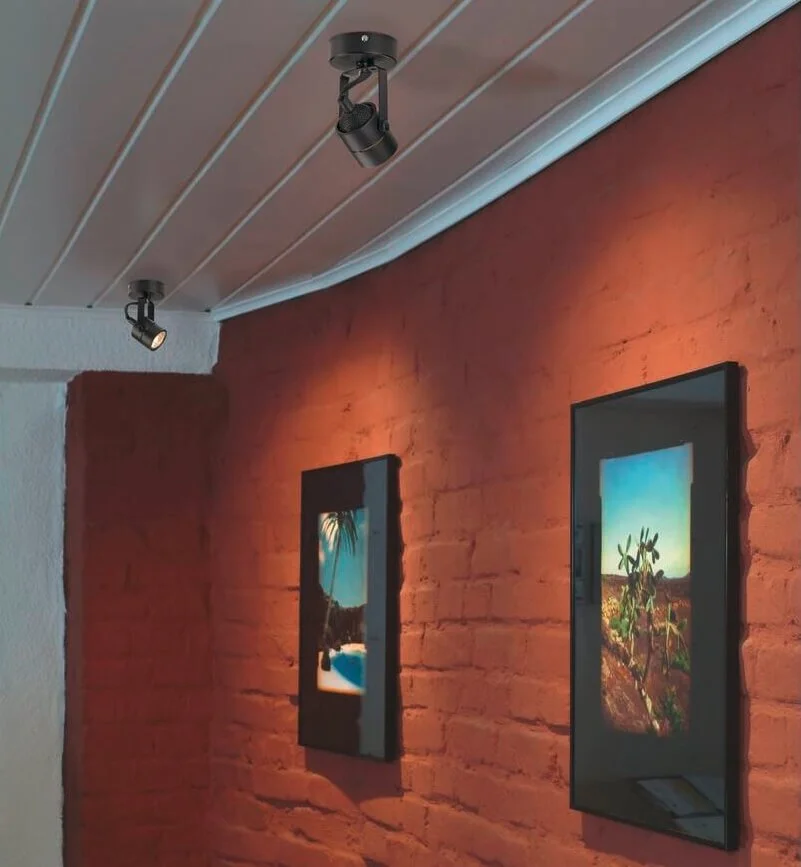
20–30° – a narrow beam, suitable for accenting pictures, niches, decorations and selected architectural elements.
-
35–60° – a versatile range for apartments; works well for zoned and functional lighting.
-
90–120° – wide light for general illumination, although it is used less often in adjustable spotlights than in ceiling lights or panels.
In a small apartment, it often works well to combine different beam angles. Wider light can provide general brightness, while narrower beams can accent walls, shelves and decorative details.
Dimming and lighting control
Dimming is very useful in small apartments because one room often performs several functions. In the morning, you may need brighter light; during work, neutral and even illumination; and in the evening, softer, more atmospheric light.
Before buying, check whether the luminaire is dimmable and which control system it works with. Depending on the model, this may be a traditional dimmer, DALI, a smart system, wireless control, remote control or an app. Not every LED spotlight works with every controller, so compatibility should be confirmed before installation.
Before buying a spotlight, check:
- whether the luminaire fits the selected system: magnetic, 1-circuit, 3-circuit or recessed;
- what colour temperature it has and whether it offers CCT adjustment;
- what its luminous flux and beam angle are;
- whether it is dimmable and which controller it works with;
- what IP rating it has, especially if it will be installed in a bathroom or kitchen;
- whether the manufacturer provides CRI, warranty details and full technical data.
5 interior lighting tricks to visually enlarge a small apartment
Well-chosen LED spotlights can do much more than simply brighten an interior. Properly directed light can change the perceived proportions of a room, visually raise the ceiling and add depth even to a very small space.
1. Direct light towards the walls
In small interiors, it is worth illuminating vertical surfaces. Bright walls appear more distant, which makes the room feel larger. Adjustable ceiling spotlights can be positioned so that the light softly washes the wall behind a sofa, near a table, in a corridor or beside a shelving unit.
Avoid a layout in which all spotlights shine only vertically downwards. This can create strong patches of light on the floor while leaving the walls in shadow, making the interior feel lower and more enclosed.
2. Highlight the ceiling and upper parts of the walls
Light directed towards the upper parts of walls or reflected from the ceiling can visually raise the room. This effect is especially useful in apartments with low ceilings. It can be achieved with spotlights set at the right angle, linear lighting or LED profiles installed near the ceiling edges.
3. Combine spotlights with a mirror
A mirror enhances the effect of light and adds depth to a room. In a small hallway, bedroom or living room, it is worth positioning a spotlight so that it illuminates the person standing in front of the mirror or the wall nearby. Avoid directing strong light straight into the mirror surface, as this may cause glare.
4. Use light to zone the space
In a studio apartment or small living room with a kitchenette, light can replace some architectural divisions. Warmer 3000 K light works well in the relaxation zone, while neutral 4000 K light is suitable above the kitchen worktop, desk or hallway. This makes the apartment more functional while keeping it open and visually coherent.
5. Accent niches, shelves and details
Illuminated details add depth and character to an interior. A spotlight with a narrower beam angle can highlight a picture, shelf, wall texture, plant, decoration or niche. Such accents make the space feel more designed and less flat.
What should you check before buying?
Before choosing a specific model, it is worth carefully checking the technical parameters and installation requirements. The guide on what to consider when choosing a ceiling lamp may also be helpful.
-
CE marking and compliance with standards – the product should meet the requirements for lighting luminaires applicable in the European Union.
-
IP rating – IP20 is usually sufficient for a living room, bedroom or hallway, but bathrooms and areas exposed to moisture require a higher protection rating matched to the installation zone.
-
System compatibility – magnetic, 1-circuit, 3-circuit and recessed spotlights are not interchangeable.
-
Build quality – a solid housing, effective heat dissipation and stable power supply affect the durability of the luminaire.
-
Dimming capability – it is worth checking this before purchase, not after installation.
-
Warranty and availability of parts – the more complex the system, the more important future access to compatible components becomes.
FAQ – common questions about adjustable LED spotlights
Are magnetic spotlights suitable for low ceilings?
Yes. Magnetic track systems often work well in low rooms because they have a slim form and a modern appearance. However, the mounting type, profile height, power supply method and manufacturer’s installation recommendations should always be taken into account.
What colour temperature is best for a small apartment?
For relaxation areas, 3000 K is usually chosen, while 4000 K works well for the kitchen, workspace and hallway. In small apartments, combining both colour temperatures or using luminaires with CCT adjustment can be a very practical solution.
How many spotlights do I need in a 12 m² room?
There is no single universal number because it depends on luminaire output, beam angle, wall colour, ceiling height and the room’s function. As a rough guide, a 12 m² room may use several light points, for example 3–5 adjustable spotlights on a track or a larger number of lower-output downlights. Even light distribution is more important than the number of luminaires itself.
Can LED spotlights be dimmed?
Yes, but only if the luminaire is marked as dimmable and is compatible with the selected control system. Before buying, check the compatibility of the spotlight, power supply and dimmer or controller.
Does track lighting work in a small apartment?
Yes. Track lighting is a very practical solution for small apartments, especially in living rooms with kitchenettes. It allows several zones to be lit from one mounting line and makes it easier to adjust the position of luminaires than with fixed ceiling points.
What CRI should I choose for an apartment?
For most home applications, CRI 80 is the minimum acceptable level. For a living room, kitchen, wardrobe, bathroom with a mirror and premium interiors, it is worth choosing CRI 90 or higher. This makes colours look more natural and the interior more visually refined.
Summary
Adjustable LED ceiling spotlights are one of the most practical lighting solutions for a small apartment. They allow you to direct light precisely, define functional zones, highlight details and visually enlarge the space. A well-planned system can replace several random lamps and create a coherent, modern effect.
For contemporary interiors, a 48 V magnetic track system is worth considering. For more economical projects, a classic track lighting system may be the better choice, while spots or downlights are ideal for minimalist suspended ceilings. When choosing lighting, pay attention to colour temperature, lumen output, CRI, beam angle, dimming capability, IP rating and compatibility with the mounting system.
If you want to choose lighting for a studio apartment, small living room, hallway or apartment with a kitchenette, explore the offer at SalonLED.pl and compare adjustable LED spotlights, track lighting systems, magnetic track systems and recessed luminaires available in one place.