Round Stone Wall Lights – How to Choose the Right One?
09/06/2026 12:23:09
BLOG

The largest selection and a wide range of LED stair lights is one of the key advantages of our stair and corridor lighting offer. We provide modern, energy-efficient LED stair luminaires in 230V and 12V versions, designed for illuminating stairs, corridors, stairwells and circulation areas—both in private homes and in hotels, offices, commercial buildings and outdoor spaces.
In our store you will find indoor and outdoor LED stair lights that ensure optimal light levels, improve safety after dark and enhance the architecture of the interior. Our range includes products from renowned manufacturers such as Skoff, Zamel Ledix, Elkim, BPM, Astro Lighting and SLV.
The assortment includes both surface-mounted and recessed stair lights, installed in junction boxes or directly into prepared openings. All models are distinguished by high build quality, durability and excellent lighting parameters. If you are looking for reliable LED stair lighting that combines functionality, aesthetics and long-term performance, you will find perfectly matched solutions in our offer.
There are 223 products.
sortSort by:
LED stair lights are now one of the key solutions in the design of modern interiors and safe circulation spaces. Used in single-family homes, apartments, stairwells, corridors, hotels, offices and commercial buildings, they combine functional, aesthetic and orientation purposes. Properly selected LED stair lighting guides users through the space, increases safety after dark and enhances the architecture and finishing character of the interior.
Thanks to the dynamic development of LED technology, contemporary stair luminaires offer far more than simple point illumination. They are technologically advanced products designed for durability, energy efficiency, compatibility with smart control systems and maximum user comfort.

The primary function of LED stair lights is to improve visibility of steps, stair edges and circulation routes. Soft, diffused light minimizes the risk of tripping, especially at night, without the need to switch on the main lighting.
LED technology consumes significantly less energy than traditional light sources. Stair lights often operate for many hours a day, so their high luminous efficiency translates directly into lower electricity bills.
High-quality LED stair luminaires achieve a lifespan of 30,000–50,000 operating hours. This means years of maintenance-free use without frequent replacement of light sources.
LED stair lighting has become an integral part of interior design. Minimalist forms, a wide range of housing finishes and various light colours make it easy to match the luminaires to modern, classic, industrial or premium interiors.
LED stair lights are available in several power supply variants.
230V models do not require an additional power supply, but due to built-in electronics they usually require a mounting box, most commonly Ø60 mm.
Low-voltage versions (10V, 12V or 14V) require a suitable constant-voltage or constant-current power supply, for example 350–700 mA, offering greater installation flexibility and an increased level of safety. The choice of power system should depend on the installation design and the stage of the investment.
LED stair lights are available in a wide range of light colours. Warm white (2700–3000K) is ideal for residential interiors, neutral white (4000K) is a versatile and functional solution, while cool white (5000–6000K) is recommended for technical areas. Decorative options, including blue light and RGB, are increasingly popular in contemporary architectural designs. The right colour temperature affects not only aesthetics but also visual comfort and ergonomics.

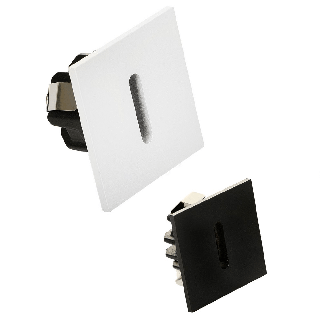
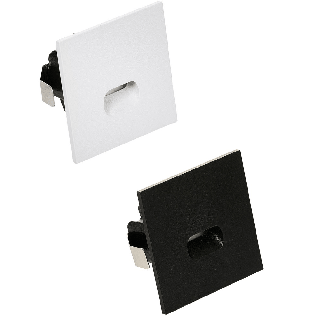
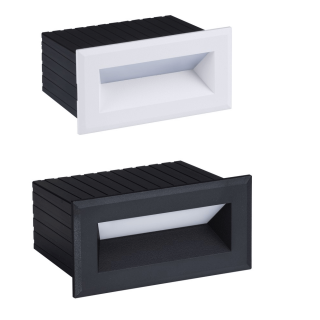
Recessed stair lights are installed in walls, steps or risers. They provide a minimalist visual effect and discreetly guide light along circulation paths. This is the most commonly chosen solution for modern interiors.
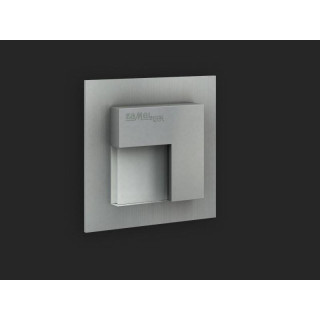
Surface-mounted stair lights are ideal where recessed installation is not possible. They offer easy installation and a wide variety of forms, making them suitable for renovation projects and retrofit applications.
These luminaires are designed for standard electrical junction boxes. They simplify replacement and allow for a clean, aesthetic wall finish without interfering with the stair structure.
LED stair lights with motion and twilight sensors are gaining rapid popularity. Automatic activation only when needed significantly reduces energy consumption while increasing user comfort. Advanced systems allow for sequential activation of luminaires, so only the section of stairs or corridor currently in use is illuminated. This solution is ideal for private homes as well as hotels, offices and public buildings.
Indoor LED stair lights are designed with a focus on aesthetics, precise light distribution and low power consumption. They form a coherent part of interior design and enhance everyday comfort and safety.
Outdoor applications require luminaires with increased ingress protection, at least IP54 and most commonly IP65. These fixtures are resistant to moisture, dust and changing weather conditions, making them suitable for entrances, terraces, garden steps, retaining walls and building façades.

Before purchasing LED stair lights, it is essential to verify the diameter of the mounting box or installation opening and to plan the layout of the luminaires at the design stage. For low-voltage systems, selecting the correct power supply is critical, while outdoor installations require an appropriate ingress protection rating. Proper installation ensures safe operation and optimal lighting performance.
When selecting LED stair lights, consider the type of power supply, installation method, light colour and output, housing colour and material, the presence of a motion sensor, and whether the application is indoor or outdoor. Well-chosen LED stair lighting is a long-term investment in safety, aesthetics and functionality.
LED stair lights combine advanced technology, high functionality and timeless design. They respond to real user needs, meet the expectations of architects and interior designers, and align perfectly with the trends of energy-efficient and intelligent building solutions. By choosing high-quality LED stair luminaires, you invest in safety, durability and refined aesthetics—whether for a private residence or a commercial project.

LED strips installed under the stair nosing provide a continuous, uniform line of light and create a very modern, decorative effect. However, they require aluminium profiles, proper thermal management and precise power supply selection. Stair lights installed in the wall or riser are easier to operate, offer better control of light direction and are more often chosen as a purely functional, circulation-oriented solution. In practice, LED strips are preferred by users focused on visual impact, while stair luminaires are selected for durability and functionality.
In most cases, stair lights are installed at a height of approximately 40–50 cm above the step, so that the light illuminates the stair surface rather than shining directly into the user’s eyes. Spacing depends on the luminous output and beam angle of the fixture, but in practice, installation every 2–3 steps is most common. Final positioning should always be verified in relation to wall colour, stair material and stair width.
The choice depends on the overall installation concept. 230V luminaires are easier to install because they do not require additional power supplies, but they do require properly prepared wiring and space for electrical components. Low-voltage systems (12V or 24V) offer greater flexibility, especially for LED strips and automation, and are generally considered safer. In modern projects, low-voltage systems with a dedicated power supply are increasingly preferred.
The power supply should be selected based on the total power consumption of the LED strip, calculated as watts per metre multiplied by the total length. A power reserve of approximately ±20% should be added to prevent the power supply from operating at its maximum capacity. For longer runs, it is recommended to divide the installation into sections or feed the strip from multiple points to avoid voltage drops and uneven brightness.
Proper planning at the installation design stage is essential. Stair lighting can be controlled using traditional two-way switches, motion-sensor-based automation, or a combination of both. In automated systems, it is important to separate circuits, allocate space for power supplies and controllers, and logically position motion sensors, for example at the top and bottom of the staircase. A well-designed system ensures predictable operation and user comfort.
Yes, especially in circulation areas used at night. Motion sensors activate the lighting only when the stairs are in use, significantly reducing energy consumption. An alternative solution is constant, very low-level night lighting. The choice depends on user preferences and the specifics of the building—motion sensors provide automation, while night lighting ensures continuous orientation.
The key factors are selecting luminaires with appropriate optics and shielding, as well as installing them at the correct height. The light should illuminate the steps, not shine directly into the user’s eyes. Choosing warm or neutral white light and luminaires with a recessed LED source also helps. Well-designed stair lighting is clearly visible but never uncomfortable.
In residential interiors, warm or neutral white is most commonly chosen, as it provides comfort and a natural appearance of materials. Cool white is sometimes used in modern or technical spaces, but it creates a more contrast-heavy effect. Decorative colours and RGB lighting are mainly selected for designer projects and architectural features.
For outdoor applications, luminaires with an increased ingress protection rating are required to withstand moisture, dust and changing weather conditions. Stair lighting at entrances, on terraces or in gardens must be suitable for outdoor use and made of durable materials. This is essential for safety and long-term reliability.
LED stair lights are designed for long-term operation and can remain on for many hours without negatively affecting installation safety. Due to the low power consumption of individual luminaires, energy use is minimal and heat generation is very low. In practice, many users set stair lights to operate as permanent night lighting or at a very low brightness level, improving nighttime safety without significantly increasing operating costs.
See also other lighting solutions for corridors:check_circle
check_circle