Designer LED Mirrors
08/01/2026 09:49:51

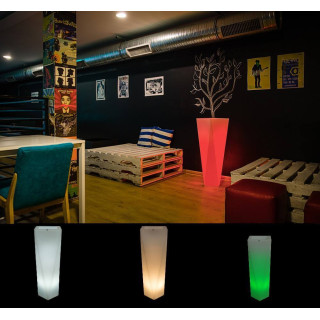
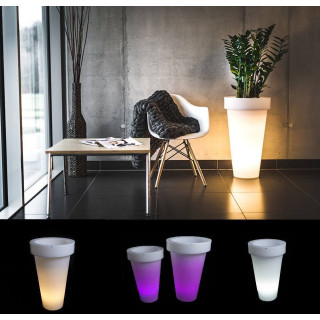
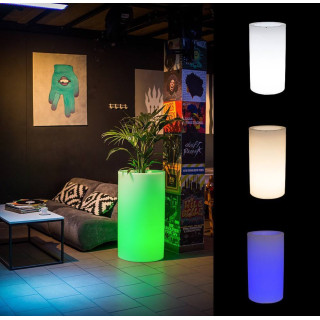
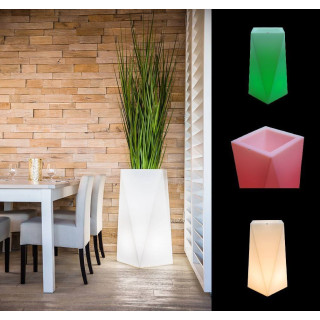
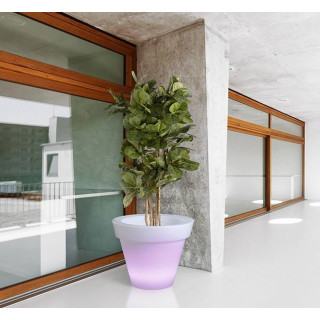
LED planters (illuminated planters, light-up pots) combine a real planting space with soft decorative lighting. In other words, you get one object that organises the layout, highlights greenery, and creates atmosphere — without adding extra wall or ground fixtures. That’s why illuminated planters are widely used across Poland and Europe: they work at home (balcony/terrace), at entrances, and in commercial spaces (restaurants, hotels, event zones).
There are 6 products.
sortSort by:
Most often, LED planters act as accent lighting — they don’t replace main lighting; they create mood and highlight zones.

The key is how evenly the body diffuses light and how well it handles outdoor conditions. That’s why material, IP rating and power method are just as important as design.
High-quality lines often use polyethylene (PE/LLDPE) made by rotational moulding. This approach is valued globally because it’s impact-resistant and weather-ready, while the translucent “opal” body works as a diffuser, delivering smooth, even glow. The result is a cleaner look, better durability, and easier maintenance.
IP65 offers strong protection against dust and water jets — excellent for terraces and gardens.
IP67 supports temporary immersion under defined test conditions — a very high safety level for rain and splashes, but not a blanket promise for permanent underwater use.
IP68 may appear in selected solutions under manufacturer-defined conditions (varies by construction).
For Polish and broader European weather (rain, snow, temperature swings), choose outdoor-rated models with clearly stated IP and the right sealing and power setup.
Across Europe, 230V is standard, making corded LED planters ideal for consistent, all-night output. Cordless LED planters (rechargeable or solar) give maximum freedom — perfect for events and flexible layouts.
Depending on the product tier, you may find:
Depending on the range, you may get:

The best choice matches your location, power plan, and plants. Use this checklist:
Check not only outer dimensions, but also the insert/shelf and planting capacity — crucial for larger plants and stability.
If you want the easiest maintenance, choose products with clear specifications and service-friendly solutions (for example, replaceable light sources where applicable).
These details most often reduce comfort or the final effect:

Yes — provided you choose an outdoor-rated model with a clearly stated IP rating and a specification confirming it is intended for external use.
For a typical terrace and garden, IP65 is usually sufficient. Consider IP67 if the planter will be exposed more often to heavy splashing and harsher conditions — noting that IP67 refers to temporary immersion under standardised test conditions.
Yes, as long as it is an outdoor version with an appropriate IP rating and the power supply and connections are properly protected. In practice, what matters most is the enclosure’s tightness, sealing, and correct connection method in line with the model’s intended use.
Yes — corded 230V models require a safe outdoor power outlet or connection point. If you cannot route a cable conveniently, choose a cordless model (battery/solar/charging — depending on the range).
Charging method and runtime depend on the specific model (battery/solar/USB/USB-C) as well as the selected brightness and mode. The most reliable approach is to follow the parameters stated in the product specification for the exact item.
Warm white is the most cosy and “hotel-like” (relaxation areas, entrances, lounge zones). Cool white delivers a more modern, technical effect and emphasises clean lines and geometry more strongly.
RGB provides a colour palette. RGBW adds a dedicated white channel, so white light can look more natural while colours remain equally effective.
Often yes — especially in RGB/RGBW versions, a remote is commonly included. App control is available in selected lines, depending on the model.
Yes, if the planter is designed for a replaceable light source (e.g., E27). In planters with an integrated LED module, replaceability depends on the module’s construction.
In most solutions, yes — the planting section is separated from the lighting (e.g., via an inner insert or shelf), which makes plant care easier. The exact construction depends on the model.
At Salon LED, we recommend LED planters based on real-life usage conditions: where they will be placed (garden/terrace/balcony/HoReCa), whether they need to shine daily or only occasionally, and what lighting effect you want to achieve (warm white, cool white, RGB/RGBW). In our product descriptions, we rely on the parameters provided in the manufacturers’ documentation (including IP rating, power supply method, control options, and material), and we advise when a 230V version is the better choice and when a cordless option makes more sense. If you tell us your placement location + desired effect + preferred power option, we will point you to the safest and best-value choices within your budget.

In this category you’ll find LED planters that combine design with real-world usability: even diffused glow, practical planting space, and outdoor-relevant specifications (IP rating, weather resistance, colour options and control — depending on the model). If you want a fast, high-impact upgrade for a terrace, garden, or entrance area, illuminated planters are one of the most effective and simplest solutions.
Explore our other lighting solutions for both indoor and outdoor spaces:
check_circle
check_circle