Top 7 Stone Wall Lights – 2026 Ranking
10/17/2026 18:33:51
Filter By
Filter By
BLOG

Solar spike lights (often searched as solar stake lights) are a simple way to light your garden without cables, trenching or electrical modifications. They work perfectly along pathways, in flowerbeds, on patios, near driveways and at entrances—anywhere you want clear wayfinding after dark while still creating ambience. During the day, the solar panel charges the internal battery, and at dusk the light switches on automatically (via a dusk sensor). Selected models also feature a PIR motion sensor, which improves security and saves energy by activating brighter light only when it’s actually needed.
There are 8 products.
sortSort by:
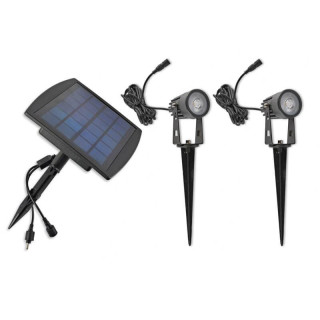
This category isn’t uniform: it includes solar spike spotlights (directional beams), decorative stake lights, and functional pathway posts. So instead of choosing based on looks alone, start with the application and a few parameters that truly determine the end result:
For gardens, a sensible baseline is often IP44, but in highly exposed areas (heavy rain, mud, dust) it’s wise to choose a higher protection level—always verify the exact rating in the product datasheet. For example, within this category you may find IP44-rated models, so it’s not accurate to assume one IP class applies to the entire group.
Warm white (approx. 2700–3000K) creates a cosy ambience and works especially well in relaxation zones.
Neutral white is the most versatile option for circulation areas.
Cooler white increases contrast and visibility, but can feel a bit clinical.
You’ll also encounter models with adjustable colour temperature (from warm to cool) and RGB versions for decorative effects—depending on the brand and model.
With solar lights, it’s not the nominal power that matters most—it’s LED efficiency, optics, and energy management.
For pathways, diffused light is usually more comfortable (less glare). For highlighting plants, sculptures or architectural details, spotlights with a tighter beam deliver a stronger accent.
A dusk sensor is the baseline for convenience—the light turns on automatically after dark. A PIR motion sensor is extremely useful near entrances, driveways and darker corners, but it’s not standard on every model—if it’s essential for you, filter your selection by this feature.
If you want stable operation after dark (especially on cloudy days), battery capacity and panel charging conditions matter more than advertised wattage. In practice, the battery often decides whether a lamp still performs well after 2–3 seasons.

Solar garden stake lights operate in tougher conditions than indoor fixtures: rain, dust, temperature swings and UV exposure. Instead of relying on vague waterproof claims, think in terms of the IP rating and the housing material.
IP44 and above – a typical starting point for garden use; sufficient for most applications along beds and paths.
Higher IP – a better choice for exposed, dirt-prone areas (e.g., near a driveway, without an overhang, close to sprinklers).
Also pay attention to the spike construction and mounting stability—the more securely the light sits in the ground, the better it handles seasonal soil softening and accidental knocks.
In practice, customers tend to choose these lights in two ways: “I want ambience” or “I want visibility.” The best results usually come from combining both.
A solar spike spotlight is a strong choice when you want an accent: to uplight a tree, shrub, ornamental grasses, a rock, a planter, a sculpture, or a section of façade. The biggest advantage is directional control—you aim the beam and build outdoor “scenes” without cables.
Practical tip: aim spotlights at an angle rather than directly toward eye level from a path—this looks better and feels more comfortable.
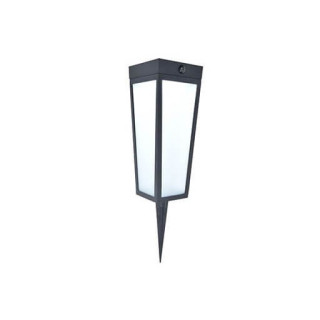
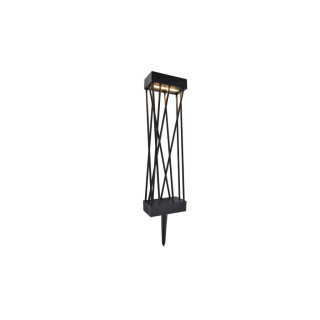
Decorative stake lights create subtle points of light in planting beds and near the patio. They’re ideal when you don’t need strong illumination—just a gentle outline of a path or evening ambience. Decorative forms (e.g., sparkle effects, flame-like effects, globes, diffused shades) can set the mood even at lower brightness levels.
If you want a refined, cohesive look, stick to one style throughout the garden—e.g., all-black minimalist fixtures or one consistent family of shapes.
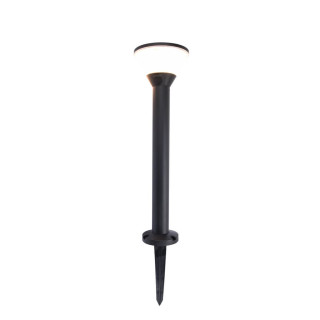
Pathway stake lights typically use a more practical light distribution: they illuminate the ground and the edges of circulation routes. Near entrances and driveways, consider models with PIR—they brighten when someone approaches, while operating more efficiently the rest of the time.
The biggest advantage is speed: you can improve both function and aesthetics in a single evening.
No electrical installation – stake it in, position it, and it works.
Flexible layout – easy to move when you change planting or path layouts.
Energy savings – solar power plus automation limits light output to what’s needed.
Better night-time orientation – light guides movement and improves comfort.
Decorative effect – highlight plants and create patio ambience.

The solar panel needs daylight—shade (especially under dense shrubs) is the most common reason for weak performance. In autumn and winter, shade areas grow, so consider seasonal changes.
Along walkways, rhythm usually wins: more lower-output points at regular intervals tend to look better than a few very bright lights. Avoid glare—light should land on the surface, not at eye level.
Dust and pollen can significantly reduce charging. Wiping the panel with a damp cloth occasionally is the quickest, lowest-cost way to improve runtime.
If runtime drops after a few seasons, the battery is usually the reason. Depending on the design, it may be replaceable—which can restore performance for additional seasons.
Paths and entrance: solar path lights / solar mini posts, diffused light, minimum IP44.
Plants and details: solar spike spotlights with adjustable beam direction.
Patio and beds for ambience: decorative stake lights, ideally warm white or adjustable colour temperature.
Driveway and dark corners: models with a PIR motion sensor (if security matters).
No. A dusk sensor is common, but PIR is only available in selected models—check the specification.
Most people start with IP44; for highly exposed locations, choose a higher IP level depending on conditions and mounting.
Yes, but usually for shorter periods. In winter, sun exposure and a clean panel are crucial; in shade, performance drops noticeably.
Warm white usually looks best in relaxation zones. For pathways and higher visibility, neutral or cooler white can work better—depending on your garden style.
Keep a regular rhythm and aim light at the surface, not toward the eyes. The more consistent the spacing, the more refined the result looks.
For accents—often yes. For strong, continuous illumination over large areas, mains-powered solutions usually perform better (e.g., in-ground fixtures or wired exterior LED lighting).
You’ll find solar stake lights with different colour temperatures—from warm white (2700–3000K) to cool white (even around 6500K), and sometimes RGB for decorative scenes. In practice:
2700–3000K: patio, flowerbeds and relaxation areas (warm and cosy)
~4000K: a versatile choice for pathways and entrances
5000–6500K: when visibility and contrast are the priority (e.g., near a driveway)
RGB: for occasional decorative scenes and effects

Installing in shade – the panel won’t charge the battery properly, so the light runs briefly.
Too-wide spacing along paths – lighting becomes patchy and stops guiding movement.
Glare – position the fixture so light works on the ground or the plant, not into the eyes.
Not cleaning the panel – dust and pollen reduce charging faster than most people expect.
See also:
check_circle
check_circle