Round Stone Wall Lights – How to Choose the Right One?
09/06/2026 12:23:09
Filter By
Filter By
BLOG

Are you looking for lighting that genuinely improves everyday comfort—helping you stay focused at your desk, making evening reading easier, and still looking excellent on a dresser, side table, or in a home office? LED table lamps and LED desk lamps are now the most practical choice, combining energy efficiency with precise control over light output: brightness, colour temperature, and beam direction.
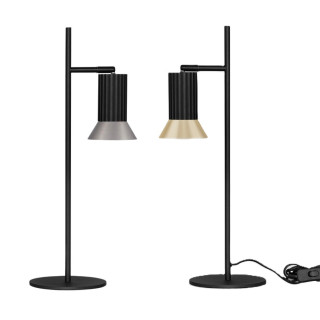
In this category you will find both LED desk lamps designed for task lighting and decorative LED table lamps—ideal for bedrooms, living rooms, children’s rooms, as well as commercial interiors (offices, hotels, restaurants). These are “freestanding” luminaires in the most functional sense: place one on a desk, tabletop, or shelf, and you instantly create better conditions for work—or a more inviting atmosphere.
There are 192 products.
sortSort by:
Start your selection with three questions:
Then move on to the parameters that genuinely affect visual comfort and everyday usability.
Choose: dimming + a wide lamp head (for an even, uniform light spread)
CCT (color temperature): 3500–4500 K (neutral white)
CRI: ≥ 90 if you work with color, print, or fine detail
Choose: warm light and convenient dimming (touch control/rotary knob)
CCT (color temperature): 2700–3000 K
Diffuser: yes (soft, comfortable light without a harsh “hot spot”)
Choose: high CRI and stable, flicker-free dimming
CCT (color temperature): 4000–5000 K
Construction: articulated arm/joints + effective glare shielding to reduce dazzle
Choose: design-forward styling + warm CCT + the option to dim
Material: glass/metal/ceramic/wood — depending on your interior style

Ceiling-mounted ambient lighting rarely provides ideal conditions for desk work or reading. An LED desk lamp delivers targeted task lighting on the work surface without having to brighten the entire room—better for your eyes and better for your budget.
LEDs deliver high efficacy at low power draw and—practically speaking—minimal heat build-up around the workspace. This means the lamp can run for long periods without creating thermal discomfort.
Modern models offer features that genuinely improve day-to-day comfort: dimming, adjustable color temperature (CCT), memory settings, work modes, and sometimes even a daylight sensor or occupancy sensor.
Lumens (lm) indicate how much light the lamp produces.
Lux (lx) indicate how much light reaches a specific surface (e.g., the desktop).
In task-lighting practice, workstations often target around 500 lx on the task area—an illumination level that makes reading and writing comfortable. You do not need to calculate this manually: choose lamps with brightness adjustment, so you can adapt output to the time of day and to the room’s general lighting.
With LEDs, there is no simple “watts = brightness” conversion. Two lamps with the same wattage can produce very different light (different LED type, optics, efficacy, diffuser design). Therefore, compare lumens, beam/spread characteristics, and dimming performance, not wattage.
The most practical option is a lamp with adjustable CCT, because one fixture can cover both daytime focus and evening comfort.
CRI (Ra) determines whether paper white looks truly white and whether colors appear natural.
A good LED lamp should remain stable even when dimmed. This is not a gimmick—it directly affects comfort during long work sessions.
The most common issues are a lamp that shines into your eyes or reflects on the screen. Choose models with:
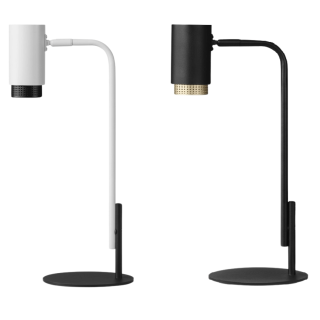
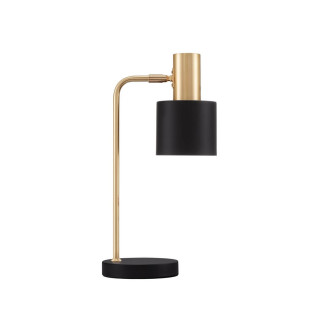
The most versatile option for work and study. They let you position the light to illuminate notes without creating reflections on the monitor. This is the best choice if you spend several hours a day at your desk.
Ideal for small desktops, teen desks, and anywhere space is at a premium. Also excellent for shelves above a desk, music stands, or precision tasks.
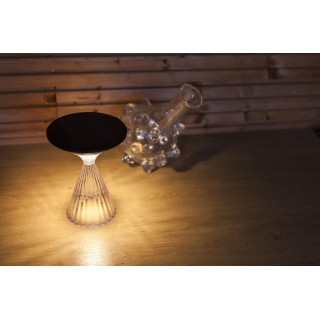
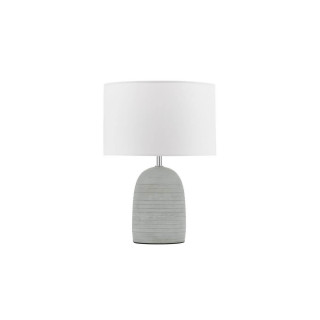
Perfect for a sideboard, bedside table, or console. They create atmosphere and elevate the interior style. Ideally, they include dimming, so one lamp can cover both ambience and practical use.
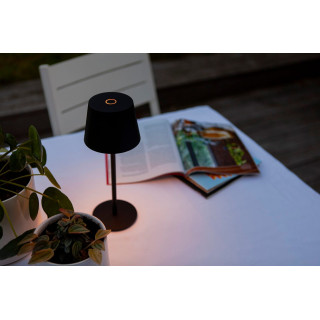
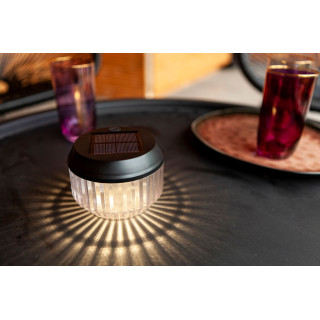
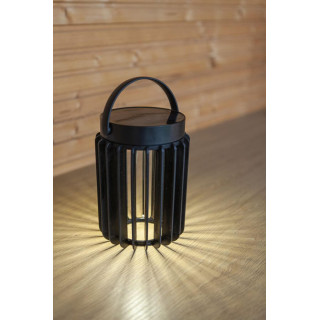
Convenient wherever you do not want cables: a dining table, a covered terrace, or an evening setup in the living room. Pay attention to runtime, charging method, base stability, and diffuser quality.

Prioritize a wide, even light distribution and adjustability. If you work hybrid, you will appreciate memory settings: one click and you return to “your” preferred light.
Warm CCT and soft light work best here. Choose models you can operate easily with one hand (touch control or a rotary knob), without hunting for a small switch.
LED table lamps are the finishing touch—the “final layer” that ceiling lighting rarely provides. They add atmosphere and visual depth. Two lamps placed symmetrically on either side of a sideboard can visually “calm” the space and noticeably elevate the perceived quality of the interior.
What matters in practice: a stable base, safe construction, simple controls, and the ability to adjust the color temperature to the time of day (study vs. evening).
→ Focus on adjustability, light distribution, CRI, and control ergonomics.
→ If the lamp is used at night, choose 2700–3000 K or a lamp with CCT adjustment.
→ Look for shielded light sources, optical filters/diffusers, and angle adjustment.
→ A fixed output is rarely ideal throughout the day.
→ The lamp fails to illuminate the center of the desk, and you start leaning forward.
In product descriptions and filters, we focus on parameters that genuinely affect comfort: color temperature (K), CRI (Ra), dimming stability, adjustment ergonomics, and the quality of materials and power delivery. We also verify compliance with EU market requirements (including energy efficiency and light-source information). When needed, we help match a lamp to a specific desk setup and work pattern.
In practical terms, the goal is simple: you should not end up with a “nice-looking lamp” that you never want to use.

In most cases, aim for around 400–600 lm for standard computer work and note-taking. If you do a lot of paper reading or frequently work in the evening, a safer range is approximately 700–1000 lm. The key feature is dimming, because the same lamp should perform well in daylight (more light) and at night (less).
For work and studying, 4000–4500 K (neutral white) is the most common choice: it supports concentration without feeling overly “cold.” 2700–3000 K is better for evening use and relaxation (less stimulating). 5000 K can work well for very precise tasks, but at home it may feel too cool. The most convenient option is a lamp with adjustable CCT.
Yes—especially if you evaluate color: drawing, graphic design, print, crafts, makeup, or textile work. In those cases, choose CRI (Ra) ≥ 90, because colors look more natural and it is easier to distinguish shades. For typical office work, CRI 80 can be sufficient, but if the price difference is reasonable, CRI 90 is a safe quality standard.
Most commonly, the cause is the driver (power supply) or the dimming method: the lamp and the control system are incompatible, or the electronics are simply low quality.
Place the lamp to the side of the desk (on the side opposite your writing hand) and aim the light downward onto the work surface—not at the screen. Typically, angling the head downward and keeping the light source out of your direct sightline works best. If reflections persist, adjust the monitor’s position relative to the window and place the lamp so it does not shine directly onto the display.
It can—usually not because of LED technology itself, but due to glare (an overly bright source in your field of view), excessive contrast between the desktop and the surroundings, or flicker. Choose lamps with a shielded source, a diffuser, and stable dimming. Set brightness to match the room’s ambient lighting, and switch to a warmer CCT in the evening.
In the evening, the bigger issue is not “LED as a technology,” but CCT that is too cool and brightness that is too high close to bedtime. After dark, use 2700–3000 K and dim the lamp. If you work for long hours, choose a model with CCT adjustment—neutral during the day, warm at night. Also avoid looking directly into the light source.
Runtime depends mainly on brightness. At maximum output the battery drains faster; at lower settings it can run many times longer. In practice, many cordless lamps are used at medium levels and can last an entire evening, sometimes several evenings. For longer runtime, choose a model with smooth dimming and convenient charging.
Charging most commonly takes a few hours, depending on battery capacity and the power source (USB/USB-C, charging base). Charging status is usually indicated by an LED: it lights up during charging and turns off or changes color when fully charged. If the lamp uses a charging base, ensure it is seated correctly on the contacts.
You can use it outdoors only if the manufacturer allows it and provides an IP rating. IP44 indicates protection against water splashes and typical dirt ingress—suitable for a covered terrace or normal garden use, but not for heavy rain or permanent exposure to weather. If the lamp has a charging port, its sealing and the lamp’s base stability also matter.

Use the filters (color temperature, CRI, dimming, type, and power supply) to narrow the selection to a few models, then compare them based on ergonomics. If you share your desk dimensions and how you plan to use the lamp (work/reading/decorative), the choice becomes even easier.
Also see our floor lamps, often purchased together with the table version:
check_circle
check_circle