- remove_red_eye 20 views

What makes a COB LED strip different?
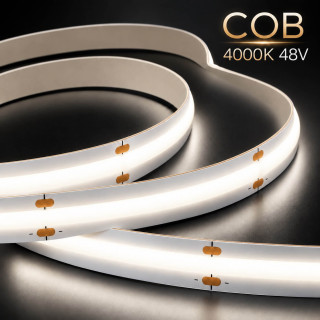
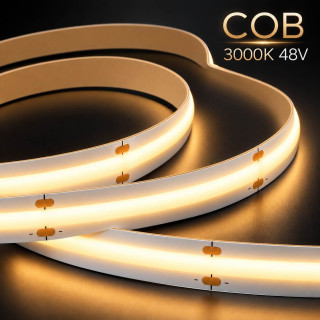
COB technology places many small LED chips directly onto a flexible circuit board beneath a shared phosphor coating. This allows a COB LED strip to produce a continuous line of light, without the pronounced dots found on many strips using individually packaged SMD LEDs. The difference is particularly noticeable in lighting profiles, around mirrors and on glossy surfaces that reflect the light source.
COB creates the continuous light effect, while 48V helps deliver power over longer distances.

48V vs 12V and 24V LED strips: where does the advantage come from?
At the same power, higher voltage means lower current. For an installation drawing 120 W on the strip side, current = power / voltage gives:
| LED strip voltage | Supply current |
|---|---|
| 12V | 10 A |
| 24V | 5 A |
| 48V | 2.5 A |
A 48V LED strip therefore draws half the current of a 24V strip and one quarter of the current of a 12V strip at the same power. Lower current reduces voltage drop along the cables and the energy lost as heat through their electrical resistance.
These losses depend on the square of the current. With identical cable resistance and the same load power, theoretical cable losses at 48V are one quarter of those at 24V and one sixteenth of those at 12V. This compares cable losses, not total electricity consumption. Running costs also depend on strip wattage, operating hours and power supply efficiency.
Up to 20 m of LED strip powered from one end
Suitably designed 48V COB LED strips allow a continuous run of up to 20 m with a single power feed at one end, without additional feeds along the strip. This simplifies ceiling perimeter lighting, long corridors, reception areas and retail displays. Reduced voltage drop helps maintain even brightness rather than a visibly dimmer end section.
The maximum run also depends on wattage per metre, copper track cross-section and circuit design. Confirm the 20 m rating in the product documentation. A 40 m reel does not automatically mean that its entire length can be powered from one end.
Specially designed 24V strips can also support long runs. The main electrical advantage of 48V is its lower current at the same power. For a short shelf light, a well-chosen 12V or 24V strip can still be a suitable option.
Less wiring, simpler installation and more design freedom
- Fewer power feeds: cables are easier to plan and conceal within ceilings or fitted furniture.
- Fewer connections: a long strip in one piece reduces the number of connectors and joints that need careful assembly.
- More efficient installation: a simpler layout can reduce fitting time, particularly in hotels, shops and large interiors.
- Easier power distribution: lower current also helps reduce losses between the power supply and the strip. Cable size must still suit the load and distance.
IP20 48V COB LED strips for dry interiors
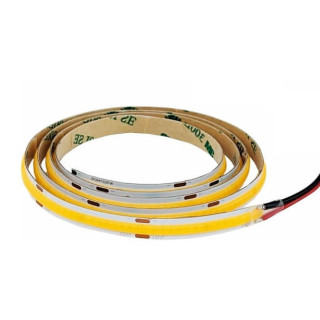
An IP20 COB LED strip suits dry, sheltered locations such as ceiling coves, wardrobes, cabinets and living room joinery. Without an additional waterproof enclosure, it is easier to fit into slim lighting profiles. IP20 provides no protection against water, so this version is unsuitable for locations exposed to flooding or splashes.
IP67 48V COB LED strips: protection against dust and water
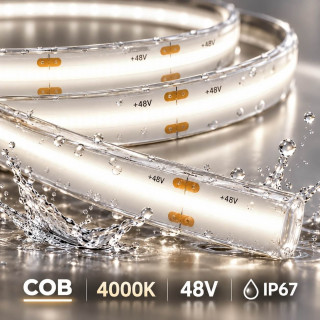
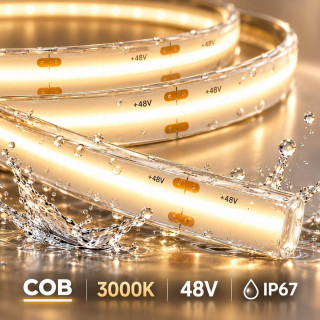
An IP67 COB LED strip has a sealed enclosure that extends its use to moisture-exposed locations. Versions approved by the manufacturer for outdoor installation can illuminate terraces, facade details and garden structures. In bathrooms, the strip and power supply must be selected for the specific installation zone.
IP67 means dust-tight protection and protection against the effects of temporary immersion under defined conditions. It does not indicate suitability for continuous underwater use. Check UV resistance and operating temperatures separately. After cutting the strip, seal the ends and connections according to the manufacturer's instructions to maintain the required protection.

3000K or 4000K: which colour temperature should you choose?
A 3000K COB LED strip produces warm white light that creates a welcoming atmosphere in living rooms, bedrooms and dining areas. It complements wood, beige finishes and warm-toned stone. A suitable IP67 version can extend the same lighting character into selected outdoor spaces.
A 4000K COB LED strip provides neutral white light, often chosen for worktops, wardrobes, offices and retail displays. Match the colour temperature to the task and surrounding lighting. For more faithful colour rendering, look for a CRI of at least 90. Neither 48V nor COB technology alone guarantees high colour rendering quality.
How to choose a power supply and install a 48V COB LED strip
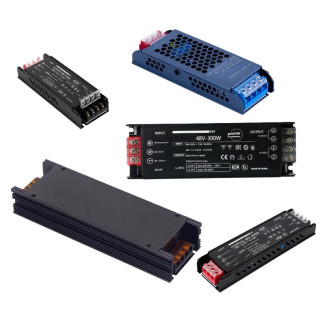
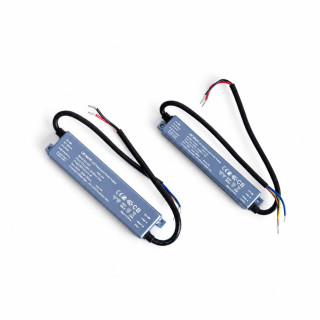
You need a 48V DC constant-voltage power supply. Calculate the load by multiplying strip length by wattage per metre: for example, 20 m × 8 W/m = 160 W. A 200 W power supply would operate at 80% of its rated capacity in this example. Choose the final power margin according to the manufacturer's instructions, operating temperature and any additional loads.
Allow access to the power supply and provide adequate heat dissipation. An aluminium profile helps transfer heat away from the strip and creates a neat mounting solution. Lower cable losses do not eliminate the heat generated by the LEDs. Cut only at marked points, check the width of the IP67 version and observe the minimum bending radius.
Dimming is possible with a suitable 48V PWM controller or a compatible DALI solution. Check both the controller's voltage rating and its maximum load. A power supply or dimmer designed exclusively for 12V/24V cannot replace a 48V-compatible device.
Frequently asked questions about 48V COB LED strips
Can every 48V LED strip run for 20 m from one power feed?
No. The manufacturer must approve this length for the specific model and installation method.
Does 48V mean brighter light?
Not by itself. Compare light output in lumens per metre and luminous efficacy in lumens per watt.
Does a 48V COB LED strip use less energy than a 24V strip?
At equal wattage, the strips themselves consume the same power. The advantage of 48V is lower losses in comparable wiring.
Can an IP67 LED strip be used inside a swimming pool?
IP67 alone is insufficient for permanent immersion. You need a product specifically intended for underwater use and a suitable installation design.

Planning a long line of light? Salon LED can help you choose a 48V COB LED strip, 3000K or 4000K light, IP20 or IP67 protection and a power supply matched to your installation's length and location.