- remove_red_eye 26 views

The One-Third Rule: What Does It Mean?
h is the room height, while h/3 is the horizontal distance between the light fitting and the wall. With a 2.70 m ceiling, this gives a setback of 0.90 m. It does not mean one third of the artwork's height or the length of the angled light path.
The rule a ≈ h/3 mainly applies to fittings designed to illuminate vertical surfaces evenly, usually with an asymmetric light distribution. It helps with planning a gallery wall, but this distance alone will not make an ordinary spotlight illuminate it evenly. Optics, aiming and spacing between fittings also matter.
For a single artwork, treat the one-third rule as an initial layout guide and check the aiming angle. A track positioned 90 cm from the wall is not automatically ideal for every picture.

The 30° Aiming Angle for Individual Artworks
The commonly used museum lighting angle is approximately 30° between the beam axis and vertical, equivalent to 60° from a horizontal ceiling. This helps limit pronounced shadows from frames and surface texture, as well as reflections. It cannot guarantee that all reflections will disappear.
- Too close to the wall: steeply angled light exaggerates surface texture, and a deep frame may cast a shadow across the top of the artwork.
- Too far from the wall: reflections in glazing and shadows cast by viewers can become more likely.
How to Calculate the Distance from the Wall
When the spotlight is aligned with the centre of the artwork, calculate the setback for a 30° aiming angle using:
a = (H − z) × tan 30° ≈ (H − z) × 0.577
H is the height of the light-emitting point above the floor, z is the height of the artwork's centre, and a is the horizontal distance from the wall. Use the same units throughout. With the light at 2.70 m and the artwork's centre at 1.50 m, the result is approximately 69 cm.
| Room height | One-third rule: h/3 | 30° aiming angle |
|---|---|---|
| 2.40 m | 80 cm | Approx. 52 cm |
| 2.70 m | 90 cm | Approx. 69 cm |
| 3.00 m | 100 cm | Approx. 87 cm |
These are geometric examples, not fixed installation requirements. For suspended tracks, use the actual height of the light source. Recalculate if you change the height of the artwork.
Aiming Angle and Beam Angle: Two Different Settings
The aiming angle determines where the light points; the beam angle determines how widely it spreads. A spotlight aimed 30° from vertical may have a 15°, 24°, 36° or 50° beam. The best choice depends on the artwork's dimensions and the distance between the light and its surface.
- 15–24°: a narrow beam for smaller works, details or longer lighting distances.
- 24–36°: a medium beam range that can be a useful starting point for a single picture.
- 36–50°: a wider beam for larger works or shorter lighting distances.
With the same optics, increasing the distance makes the light footprint larger. When light strikes a wall at an angle, the footprint is usually elongated, and brightness may vary between its upper and lower sections. The stated beam angle generally marks the points where luminous intensity falls to half its peak value, rather than a sharp boundary beyond which no light falls.

Ceiling Spotlights or Track Lighting with Zoom?
Adjustable ceiling spotlights suit artworks with a permanent position. Check the tilt range before installation: the fitting must be able to aim at the intended point without its housing obstructing the beam.
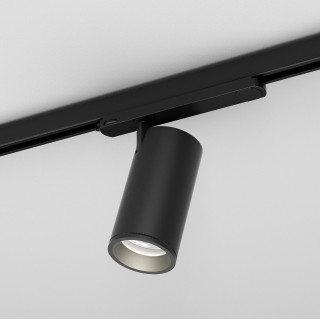
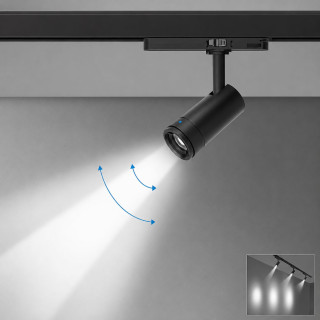
Track lighting makes it easier to rearrange a display. Compatible spotlights can move along a track installed parallel to the wall and be aimed at individual works. Moving a fitting along that track does not change its distance from the wall, so the track position still needs careful planning.
What Does an Adjustable Zoom Beam Offer?
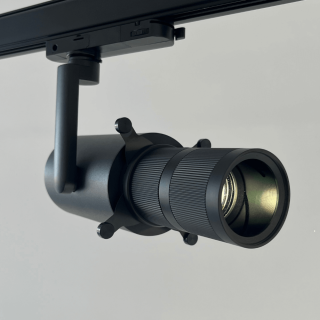
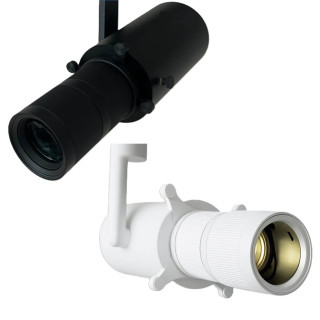
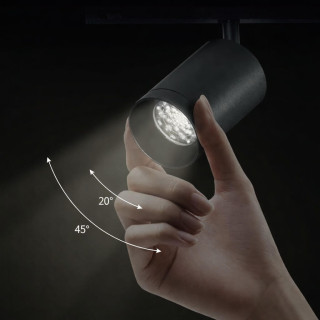
A zoom spotlight lets you narrow or widen the beam without replacing the fitting. Set the direction first, then adjust the beam width to suit the picture. For a particularly wide artwork, consider two light sources or dedicated wallwashing optics.
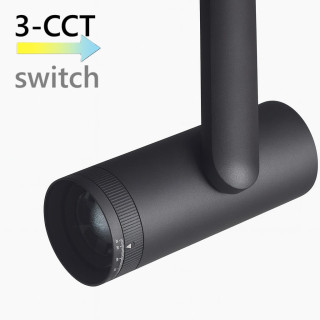
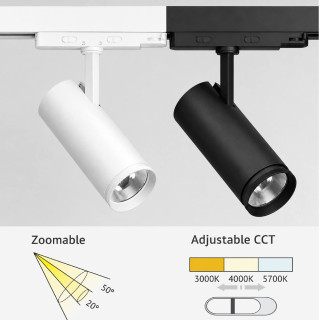
One example is the MULTILINE ZOOM 15–50°, a black 12 W LED spotlight for the MULTILINE 22 mm magnetic track system, operating at 48 V. Its adjustment ring changes the beam angle from 15° to 50°, while a switch offers a choice of 3000 K, 4000 K or 6000 K. The product specification lists CRI 90 and a luminous flux of 960 lm.

Zoom does not create a sharply defined rectangle matching the frame; that requires a framing projector. It also does not replace dimming or compensate for an unsuitable track position.

Glazed Photographs, Colour Rendering and Light Exposure
Check glazed photographs and glossy prints from normal viewing positions: standing, seated on a sofa and walking past. If the light fitting appears as a reflection, adjust its position or aim. Anti-reflective glazing can help, but correct positioning remains essential.
Choose good colour rendering, ideally CRI 90 or higher. Match the colour temperature to the artwork and interior: 3000 K gives a warmer appearance, while 4000 K looks more neutral. More light does not always produce a better result.
For original photographs, watercolours and works on paper, consider both material sensitivity and the duration of illumination. LED lighting can still cause fading. For valuable works, consult a conservator about appropriate illuminance and exposure time.
Artwork Lighting: Frequently Asked Questions
Is 90 cm from the wall always the right distance?
No. It follows the one-third rule for a 2.70 m room. For an individual artwork, its position and the spotlight's aiming angle must also be considered.
Can zoom compensate for any track position?
No. Zoom adjusts beam width, but it cannot eliminate shadows or reflections caused by poor positioning.
What should I measure before choosing the lights?
Measure the mounting height, the height of the artwork's centre and the artwork's dimensions. Then calculate the setback, select suitable optics and test the result. These details will help the Salon LED team recommend spotlights for your display.
Related products