-
Gold LED Pendant Light as a Premium Accent — How Lighting Creates Elegance in High-End Interiors 01/30/2026 13:38:51Modern floor lamps: lighting scenes and a mistake-free choice 01/28/2026 22:15:27LED Recessed Spotlights — the Invisible Heroes of Harmonious Lighting Architecture 01/16/2026 09:05:44What are the units of light intensity lux and lumen?06/13/2023 10:25:53 Advice and inspiration
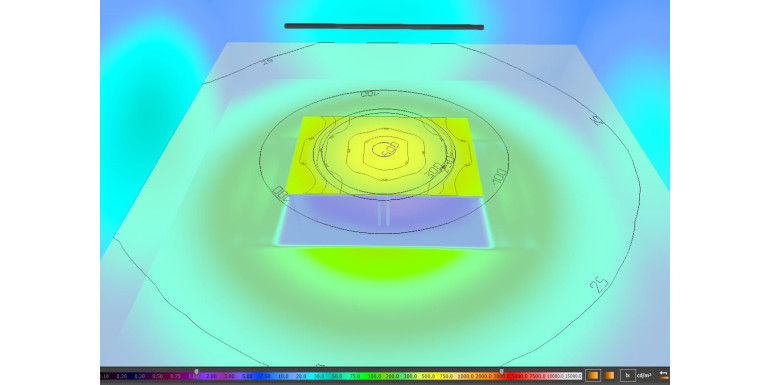
Lux and Lumens in Practice: How to Choose Lighting for Your Home and Interior
Lux vs. lumen in 30 seconds
- Lumen (lm) tells you how much light a light source or luminaire emits.
- Lux (lx) tells you how bright it is on a surface (e.g., a countertop, desk, or floor).
- Formula: lx = lm / m², therefore lm = lx × m².
- Typical targets: desk 500 lx, kitchen worktop 500–750 lx, general living room lighting 100–200 lx, bathroom mirror 500–750 lx.
This guide explains how to choose LED lighting for a room—for homeowners planning lighting themselves and for interior designers and architects. You’ll find clear definitions, a practical illuminance (lux) framework, quick lumen calculations, real-world examples, and a purchase checklist.
What is lux (lx)? Illuminance
Lux is the unit of illuminance—it describes how much light actually reaches a specific surface.
- Lux answers: Is it bright enough on this countertop/desk/mirror?
- Lux depends on: the distance from the luminaire, beam angle, ceiling height, optics, interior colours and reflectance, and light modifiers (shades/diffusers).
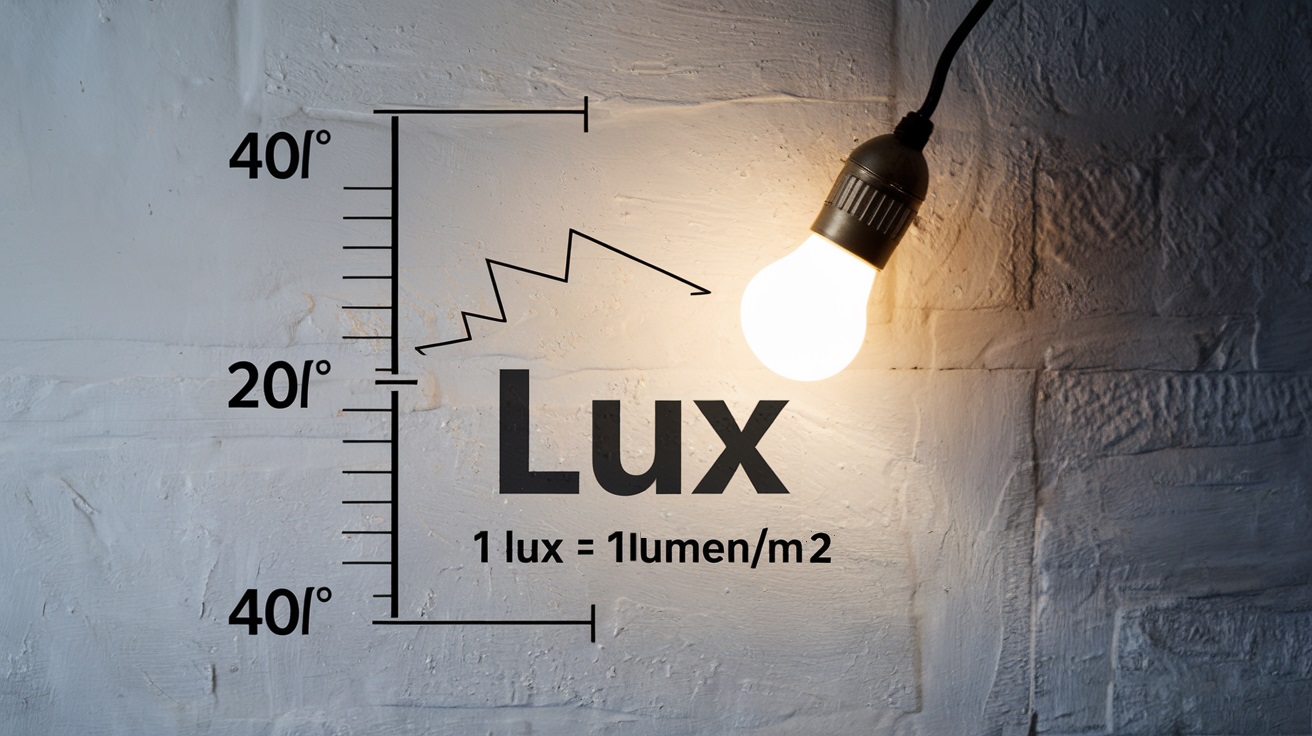
1 lux (lx) equals 1 lumen (lm) distributed over 1 m².
Where does lux really matter?
Illuminance should be assessed on the visual task plane—where your eyes actually need the light:
- Kitchen worktop / desk: measure lux on the work surface.
- Floor / circulation areas: lux is often assessed at floor level.
- Mirror / face: what matters is vertical illuminance—light “on the face,” not only ceiling light.
What is lumen (lm)? Luminous flux
Lumen is the unit of luminous flux—the total amount of light emitted by a source.
- Lumen answers: How “powerful” is this lamp in terms of light output?
- Lumens are excellent for comparing products, but they don’t guarantee the result at a specific location—that’s what lux is for.
Source lumens vs. luminaire lumens (a key purchasing nuance)
In product specifications you may encounter:
- LED module/source lumens (before the diffuser/shade),
- luminaire lumens (the light output that actually leaves the fixture).
Diffusers, opal covers, louvers, and other optical elements improve comfort and reduce glare, but they can reduce effective delivered lumens. Treat calculations as a strong starting point—and keep a margin for real-world losses.
Why does a 3,000-lumen lamp feel dim?
This is a common scenario. The most frequent causes are:
- the fixture is mounted too high (the light spreads over a larger area → lower lux),
- the beam is very wide (great ambient coverage, weaker “task light”),
- the shade/diffuser absorbs part of the output,
- the interior is dark and matte (it absorbs light),
- there is no dedicated task layer (e.g., for the countertop, desk, or mirror).
Bottom line: lumens represent potential output, but lux shows the usable result on the surface.
How many lux do you need in a room? Recommended illuminance levels (lx)
The values below are practical targets for residential interiors. In professional applications (e.g., offices), illuminance levels are often designed according to indoor lighting standards (typically around 500 lx at the workplane). At home, you select ranges more pragmatically—based on the task, occupants’ age, and available daylight.
Recommended illuminance (lux) for the home
Room / zone Lux (lx) – practical range Entryway / circulation 100–150 Stairs 100–200 Living room – general lighting 100–200 Living room – reading / desk-style tasks 300–500 Dining area – table 150–300 Bedroom – general lighting 75–150 Bedroom – reading 300–500 Kitchen – general lighting 200–300 Kitchen – worktop 500–750 (up to 1000 for precision tasks) Bathroom – general lighting 200–300 Bathroom – mirror / face (vertical) 500–750 Children’s room – general 150–300 Desk / studying / work 500 (surrounding area ~300) Walk-in closet / wardrobe 200–300 Laundry / utility room 200–300 Garage – parking 100–200 Garage / workshop 300–500 How many lux for reading and computer work?
Most commonly 300–500 lx for reading and about 500 lx for computer work—measured at the task area, not across the entire room.How to convert lux to lumens: the formula and “real-world losses”
Base formula: lm = lx × m²
In practice, add losses and a design margin (a simplified “conditions factor”):
- bright interiors, low ceiling, efficient luminaires: × 1.2
- typical home conditions: × 1.3–1.5
- dark walls, high ceiling, many shades/diffusers: × 1.6–2.0
How many lumens per m²?
It depends on your lux target:
- 100 lx → ~100 lm/m² (plus margin)
- 300 lx → ~300 lm/m² (plus margin)
- 500 lx → ~500 lm/m² (plus margin)
Quick lighting calculator
- Choose the zone and target lux from the table.
- Calculate the area in m² (room or task zone: countertop, desk, table).
- Compute: lumens = lux × m² × 1.4 (a safe starting point for most homes).
- If the interior is very bright and low—use 1.2. If dark and high—consider 1.6–2.0.
- Divide the total by the number of luminaires or sources you plan to use.
Uniformity rule (highly practical): it’s usually better to use 2–4 weaker light points than one very powerful fixture. It’s easier to achieve uniform lighting with less glare—and spaces often feel brighter even with a similar total lumen output.
Calculation examples: living room, kitchen, desk, bathroom, hallway & stairs
1) Living room 20 m² — how many lumens for a 20 m² living room (general lighting)
Target: 150 lx
150 × 20 = 3,000 lm
Margin: 3,000 × 1.4 ≈ 4,200 lm from general lighting2) How many lumens for a 10 m² kitchen?
Kitchen general lighting (10 m²):
Target: 250 lx
250 × 10 = 2,500 lm
Margin: × 1.4 → ~3,500 lmWorktop (e.g., 3 m²):
Target: 500 lx
500 × 3 = 1,500 lm
Margin: × 1.5 → ~2,250 lm directed onto the worktopConclusion: the kitchen should combine a general layer + task layer. A single ceiling fixture rarely provides comfortable worktop lighting.
3) Desk 120×60 cm (0.72 m²) — work and studying
Target: 500 lx
500 × 0.72 = 360 lm on the desk surface (theoretical)In practice, a desk lamp should deliver more: typically 600–1,000 lm, depending on beam angle and mounting distance.
4) Bathroom: mirror and face
Assume a 1.5 m² vertical zone (around the face and mirror).
Target: 600 lx
600 × 1.5 = 900 lm
Margin: × 1.3–1.5 → ~1,200–1,350 lm for mirror lighting (arranged to minimise facial shadows)5) Hallway and stairs — safety
Hallway 8 m²: target 120 lx
120 × 8 = 960 lm
Margin: × 1.4 → ~1,350 lmStairs 6 m²: target 150 lx
150 × 6 = 900 lm
Margin: × 1.4 → ~1,250 lmCandela (cd) — when it matters (short and practical)
Candela (cd) describes luminous intensity in a specific direction. It matters especially for:
- spotlights and reflectors,
- narrow beam angles,
- glare risk assessment.
Practical simplification: with directional sources, lux at a point increases as candela increases and distance decreases. That’s why two sources with similar lumens can feel very different if one concentrates light into a narrower beam.
Lux is the baseline—light quality makes the difference
If you want a functional, “premium” result, control more than lux:
Layering
Ambient (background) + task (work) + decorative/accent (mood, emphasis).
Uniformity and contrast
Excessive contrast is tiring. Aim for an even base layer and higher levels where the task is performed.
Glare (comfort)
Overly bright sources in the field of view can be uncomfortable even when lux targets are correct.
CRI and correlated colour temperature (K) — practical minimums
-
CRI ≥ 80: most residential uses
-
CRI ≥ 90: kitchen, bathroom, wardrobe (colour matters)
-
2700–3000 K: relaxation (living room, bedroom)
-
3500–4000 K: task-oriented, neutral (kitchen, desk)
How to check whether a fixture will deliver sufficient illuminance
Purchase checklist: what to verify in the product description
- Luminous flux (lm) — is it source lumens or luminaire lumens?
- Beam angle / distribution — determines lux at the task zone
- CRI (Ra) — ideally 80+, and 90+ in key areas
- Colour temperature (K) — match the room function
- Dimming capability — if you want lighting scenes
- Diffuser/shade — comfort vs. output loss
- Mounting height and distance to the work surface
How to measure lux at home
- Best option: a lux meter—measure at several points on the desk/worktop and average the readings.
- Phone apps can be indicative, but results depend on sensor quality and calibration—treat them as approximate.
Common mistakes (and quick fixes)
- One ceiling light for everything → add task lighting: worktop, desk, mirror.
- Too little vertical light → illuminate walls, mirrors, and facial zones.
- Overly harsh light points → use diffusion, shielding, and better aiming/beam choice.
- Dark interior without adjustment → increase lumens or improve distribution and layering.
- No control → add dimming or scene circuits (comfort and efficiency).
FAQ (quick answers)
Is 500 lux a lot?
It’s a typical level for visual tasks: desk work, studying, documents—and often for kitchen worktops.
How many lumens per m² in a living room?
For 150 lx, that’s ~150 lm/m² (plus margin). In practice, living rooms often land around 200–300 lm/m² due to losses and personal preference.
Why do I have plenty of lumens, yet it still feels dim?
Most often: missing task lighting, poor aiming/distribution, light-absorbing finishes, or fixtures that reduce delivered output.
Mini glossary
- Lux (lx): illuminance on a surface (how much light reaches the task area).
- Lumen (lm): total light output from a source or luminaire.
- Beam angle: how wide the beam spreads; impacts lux at the target.
- CRI (Ra): colour rendering quality (higher is better).
- CCT (K): colour appearance—warm/neutral/cool.
- Glare: discomfort caused by overly bright sources in the field of view.
- Candela (cd): luminous intensity in a direction; important for spotlights.
Summary: choosing lighting without guesswork
- Select target lux levels based on room function.
- Convert to lumens: lm = lx × m² × 1.4 (good starting point).
- Plan layers: ambient + task + accent.
- Verify fixture parameters and control glare.
- In key zones (worktop, desk, mirror), measure lux and adjust.
See also:

shopping_cart
0
Menu
- +Outdoor lighting
- +Indoor lighting
- +LED wall lights
- Line light LED
- LED profiles ALU
- +Track system
- Multiline - magnetic track system 22mm 48V
- FIVETRACK 5 mm 48V Magnetic Tracks & Luminaires
- AQFORM Multitrack 48V - Premium magnetic Stucchi track
- 3-phase track systems
- 1-Phase Track Systems
- MINILINE magnetic track lighting
- AQFORM FLATTRACK magnetic track 48V
- +Magnetic system 11mm Micro, Core11
- Black track lighting
- White track lighting
- +LED ceiling lamps, hanging and surface-mounted
- +Ceiling covers
- +LED plafonds
- LED recessed downlights
- +Hanging lamps LED
- Ceiling spotlights and spots
- Ceiling fans LED
- LED lights for paintings
- Starry Sky
- +LED floor lamps
- LED table and desk lamps
- Living room
- Bedroom
- Dining room
- LED bathroom lighting
- LED kitchen lighting
- LED stairs lighting
- +LED bulbs
- All manufacturers
- Prices drop
- New Products
- Bestseller


