-
Gold LED Pendant Light as a Premium Accent — How Lighting Creates Elegance in High-End Interiors 01/30/2026 13:38:51Modern floor lamps: lighting scenes and a mistake-free choice 01/28/2026 22:15:27LED Recessed Spotlights — the Invisible Heroes of Harmonious Lighting Architecture 01/16/2026 09:05:44Voltage in LED Lighting – 230V, 12V, 24V or 48V? Comparison and Applications12/16/2025 18:24:10 Advice and inspiration
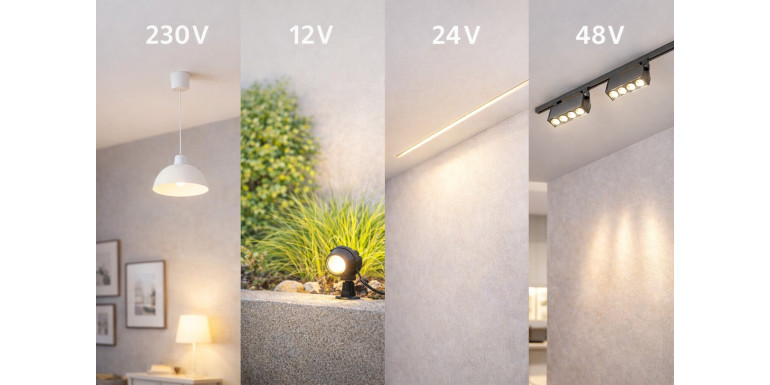
Voltage in Lighting – How It Works? Why It Matters? and Why It Now Determines the Quality of the Entire Installation
Electrical voltage is one of the fundamental parameters of any lighting installation, yet it remains one of the least understood concepts for end users. For many, it is an abstract technical value, while in practice it has a direct impact on safety, functionality, aesthetics, durability, and the future expandability of a lighting system.
With the rapid development of LED technology and modern track lighting systems, the topic of voltage has returned with renewed importance. An increasing number of investors, architects, and private clients are asking the same questions:
Which voltage should I choose? What is the difference between 230 V and 48 V? Is low voltage truly safe, and is it worth investing in?This article answers these questions comprehensively, guiding the reader from basic concepts to an informed design and purchasing decision.
What Is Electrical Voltage in the Context of Lighting?
Electrical voltage is the difference in electrical potential between two points in a circuit that enables current to flow. In lighting, it represents the energy required to power a light source—traditional or LED.
It is worth emphasizing that all modern LED light sources operate on direct current. Even when a luminaire is connected directly to the 230 V AC mains, it contains an internal power supply (driver) that converts the voltage into the appropriate operating parameters for the LEDs. The supply voltage (230V, 48V, 24V or 12V) applies to the system as a whole, not to the LED diode itself.
This means that voltage is not merely a matter of “power supply,” but a factor that:
- determines the construction of the luminaire,
- affects user safety,
- defines control options and system expandability.
Why Voltage in Lighting Matters More Than Ever Today
Just a decade or two ago, the choice of voltage was effectively non-existent—230 V dominated, and installations were designed once for many years. Today’s interiors, however, are dynamic, multifunctional, and frequently reconfigured.
Users now expect:
- design flexibility,
- the ability to modify lighting without renovation work,
- integration with smart home systems,
- a high level of safety.
These expectations have driven the growing adoption of low-voltage lighting systems, which are increasingly replacing traditional solutions, especially in premium residential projects and modern commercial spaces.
The Most Common Lighting Voltages – Overview and Comparison
230 V AC – The Mains Standard
230 V is the standard voltage used in electrical installations across Poland and the European Union. It remains widely used, particularly in conventional ceiling and wall lighting.
Advantages:
- simple installation,
- no external power supplies required,
- wide availability of products.
Limitations:
- higher risk of electric shock,
- limited system flexibility,
- more complex expansion after installation.
230V is well suited to simple, fixed installations, but it is increasingly being replaced by more advanced solutions.
12 V and 24 V – Low Voltage in LED Lighting
12 V and 24 V systems are commonly used in decorative, furniture, and technical lighting applications.
Why they are so popular:
- very high level of safety,
- suitability for use in wet or sensitive zones,
- precise light control.
Limitations:
- voltage drops over longer cable runs,
- limited power per circuit,
- the need for careful power supply selection.
These voltages are ideal for smaller installations and accent lighting.
48 V – The Modern Standard for System Lighting
48 V is now considered the optimal balance between safety and performance. It is classified as a safe voltage, while allowing significantly higher power transmission than 12 V or 24 V systems.
Why 48 V is gaining popularity:
- greater design flexibility,
- reduced energy losses,
- the ability to create extensive systems,
- perfect compatibility with track lighting systems.
48 V voltage responds exceptionally well to the needs of today’s users and architects.
Voltage and Track Lighting Systems – A New Way of Thinking About Light
Track lighting systems have fundamentally changed the way lighting is designed. Instead of fixing every light point at the electrical installation stage, users gain a dynamic system that can evolve over time.
In this context, voltage plays a critical role:
- 230 V systems emphasize simplicity,
- 48 V systems deliver maximum flexibility.
Track systems allow users to:
- freely reposition luminaires,
- add new light points,
- change the function of a space without altering the electrical infrastructure.
This is why they have become the standard in modern homes, offices, hotels, and showrooms.
The Role of the Power Supply – An Invisible but Essential Component
In low-voltage systems, the LED power supply acts as the heart of the installation. It is responsible for:
- voltage stability,
- LED protection,
- flicker-free light output,
- the overall lifespan of the system.
Selecting the right power supply has a direct impact on user comfort and system durability. It is a component that should never be treated as a secondary consideration.
User Safety and Voltage Selection
One of the primary reasons users choose low-voltage lighting is safety. The lower the voltage:
- the lower the risk of electric shock,
- the easier it is to meet safety standards,
- the greater the freedom of installation.
As a result, 24V and 48V systems are increasingly used in family homes, public spaces, and commercial projects.
How Voltage Influences Purchasing Decisions
For the end user, voltage translates into tangible benefits:
- the ability to expand the system in the future,
- enhanced interior functionality,
- better adaptation of lighting to lifestyle needs,
- increased overall investment value.
A conscious voltage choice is an investment in long-term flexibility and comfort.
FAQ – Frequently Asked Questions About Lighting Voltage
Which voltage is best for modern LED lighting?
Today, 48 V systems are the most versatile solution, combining a high level of safety with exceptional flexibility. They are no longer limited to 48 V track lighting systems only—48 V technology is now also used, for example, in LED strip lighting.Is low voltage safer than 230 V?
Yes. Voltages of 12 V, 24 V, and 48 V significantly reduce the risk of electric shock.Does LED lighting always require a power supply?
Yes. LED diodes require either constant voltage or constant current, which makes a power supply essential.Which voltage should be chosen for track lighting systems?
For modern, flexible installations, 48 V is the optimal choice. Its popularity continues to grow, and new track lighting solutions based on this voltage are being introduced regularly.Can the voltage be changed later in an installation?
Changing the voltage usually requires replacing key system components, which is why the decision should be made at the design stage. Converting a 230 V track lighting system to 48 V requires a complete modification—48 V luminaires are not compatible with 230 V tracks, and vice versa.Conclusion – Voltage as the Foundation of Modern Lighting
Voltage in lighting is no longer merely a technical parameter. Today, it is one of the foundations of conscious lighting design, influencing safety, aesthetics, functionality, and the future flexibility of the installation.
The growing popularity of low-voltage systems—particularly 48 V—clearly indicates the direction in which the market is heading. These solutions respond to real user needs and enable lighting designs that adapt to an evolving lifestyle. It is also worth remembering that low-voltage systems contribute to a longer lifespan of lighting installations.
See our track lighting systems 48V:
- Multiline modern 48V magnetic track lights and systems
- Aqform Multitrack modern lamps and magnetic tracks 48V DALI
- FIVETRACK modern 48V track system with a width of 5mm
- Miniline - small lamps and 48V magnetic track systems
- Flattrack - the lowest 48V magnetic tracks
- 11mm LED track lights and systems – modern lighting
See our 230V track lighting system 230V:

shopping_cart
0
Menu
- +Outdoor lighting
- +Indoor lighting
- +LED wall lights
- Line light LED
- LED profiles ALU
- +Track system
- Multiline - magnetic track system 22mm 48V
- FIVETRACK 5 mm 48V Magnetic Tracks & Luminaires
- AQFORM Multitrack 48V - Premium magnetic Stucchi track
- 3-phase track systems
- 1-Phase Track Systems
- MINILINE magnetic track lighting
- AQFORM FLATTRACK magnetic track 48V
- +Magnetic system 11mm Microtrack, Microline, Core11
- Black track lighting
- White track lighting
- +LED ceiling lamps, hanging and surface-mounted
- +Ceiling covers
- +LED plafonds
- LED recessed downlights
- +Hanging lamps LED
- Ceiling spotlights and spots
- Ceiling fans LED
- LED lights for paintings
- Starry Sky
- +LED floor lamps
- LED table and desk lamps
- Living room
- Bedroom
- Dining room
- LED bathroom lighting
- LED kitchen lighting
- LED stairs lighting
- +LED bulbs
- All manufacturers
- Prices drop
- New Products
- Bestseller


